


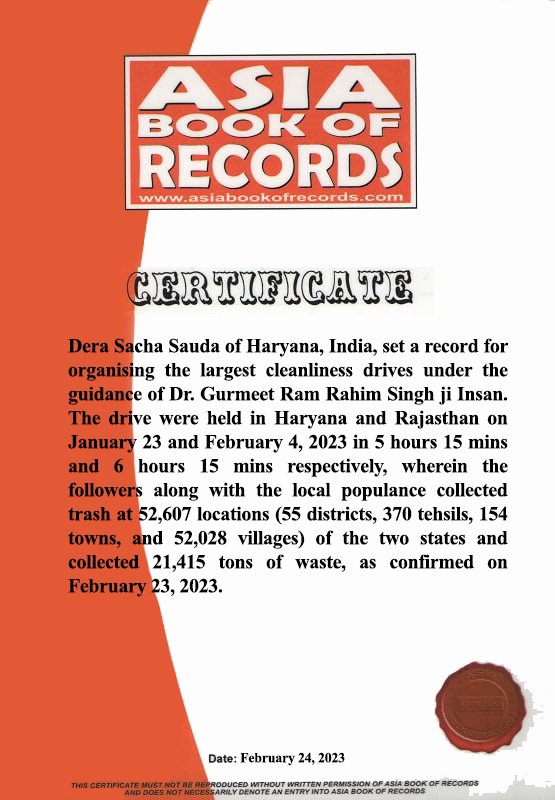
Dera Sacha Sauda’s Safai Abhiyan: A New Milestone in Cleanliness Service
Dera Sacha Sauda (DSS), a socio-spiritual organisation founded in 1948, has consistently combined spiritual teachings with practical works of public service. Under the guidance of Saint Dr. Gurmeet Ram Rahim Singh Ji Insan, one of its most visible contributions has been the large-scale Safai Abhiyan (cleanliness campaigns) carried out across India. These initiatives have now culminated in a new record-setting cleanliness drive in Haryana and Rajasthan, further strengthening the organisation’s reputation for disciplined, volunteer-driven humanitarian work.
Massive Record-Breaking Cleanliness Drive Across Two States
On 23 January and 4 February 2023, Dera Sacha Sauda volunteers undertook a massive cleanliness drive across Haryana and Rajasthan. In two carefully coordinated phases lasting 5 hours 15 minutes and 6 hours 15 minutes respectively, the teams cleaned an extraordinary 52,607 locations, covering 55 districts, 370 tehsils, 154 towns and 52,028 villages of the two states. In the process, they collected 21,415 tons of waste, as officially confirmed on 23 February 2023. For its unprecedented scale and measurable social impact, the drive was recognised as a new record in the Asia Book of Records.
The scale of this effort is remarkable not only for the numbers involved but also for the planning behind it. The Safai Abhiyan was conducted in a structured manner: advance mapping of locations, provision of tools and protective gear, and arrangements for lifting and disposing of the collected waste. This record-setting campaign is a significant environmental intervention in its own right and also a powerful public message on shared civic responsibility.
A Legacy of Volunteer-Led Cleanliness Across India
The 2023 campaign is part of a longer journey. Dera Sacha Sauda’s organised cleanliness work began with a mega Safai Maha Abhiyan in Delhi on 21–22 September 2011, when lakhs of volunteers cleaned large parts of the national capital in less than two days. This initiative, described within the organisation as a “Safai Maha Abhiyan” and externally as a mega cleanliness campaign, mobilised around four lakh volunteers and drew appreciation for its scale and impact.
Building on that experience, DSS volunteers went on to conduct similar Safai Abhiyan in other cities. Over the next few years, cleanliness campaigns were organised in places such as Jaipur, Kolkata, Indore, Mumbai, Hyderabad, Bengaluru, Rohtak, Gurugram, Noida and other urban centres, often in coordination with local administrations. These drives targeted areas that had long remained neglected in routine sanitation efforts, and transformed them within a single day by removing heaps of garbage, clearing drains and washing public spaces.
By 2014, DSS documentation recorded around 20 mega cleanliness campaigns in major cities and religious centres across multiple states. Safai Abhiyan had been conducted in India and abroad, extending the model of volunteer-led sanitation work beyond national boundaries. In recent years, the tradition has continued with campaigns such as the large-scale cleanliness drive in Gurugram and other towns, often organised in alignment with the spirit of the Swachh Bharat Mission.
While Dera Sacha Sauda holds multiple verified records in other humanitarian fields—such as blood donation, tree plantation, and disaster-relief mobilisation—its Safai Abhiyan campaigns are primarily celebrated for their public impact rather than for numerical world records. Municipal corporations and district administrations have often noted that DSS volunteers helped clear large volumes of waste, revived neglected public spaces, and initiated behavioural change by encouraging residents to take ownership of local cleanliness efforts.
This pattern of recognition reflects the practical, grounded nature of DSS’s work: instead of pursuing record titles, the organisation has focused on creating visible, long-term improvements in hygiene and civic responsibility. The appreciation it has earned across various states underscores the credibility and community value of the Safai Abhiyan since its inception.
Cleanliness as a Pillar of Spirituality and Social Responsibility
At the heart of these efforts lies a simple yet profound principle: cleanliness as an expression of spirituality and social ethics. Saint Dr. Gurmeet Ram Rahim Singh Ji Insan has repeatedly emphasised that spiritual practice must translate into tangible welfare work, and that a clean environment is essential for a healthy body, pure thoughts and a dignified life. Clean streets, public spaces and villages are viewed not only as a civic requirement but also as a reflection of respect for fellow citizens and for nature.
The Safai Abhiyan model is built on volunteerism. Members of Dera Sacha Sauda, including women, youth and senior citizens, participate in these campaigns without financial reward. They often travel long distances to join the drives, bringing with them not only physical labour but also a positive, disciplined attitude that encourages local residents to take part. This voluntary spirit has been a key reason for the success and continuity of the campaigns.
The recent record-breaking drive in Haryana and Rajasthan demonstrates how this tradition has matured over time. From the first Safai Maha Abhiyan in Delhi in 2011 to the extensive two-state campaign in 2023, Dera Sacha Sauda has shown that large-scale cleanliness work is feasible when communities are motivated, organised and united by a shared purpose. Municipal authorities and local communities in many cities have acknowledged that these campaigns not only cleaned physical spaces but also contributed to a notable reduction in vector-borne diseases such as dengue, while raising awareness about hygiene and inspiring sustained local efforts.
Impact, Recognition, and Future Prospects
Looking ahead, the Safai Abhiyan framework offers an important example for civil society. In a country where solid-waste management remains a significant challenge, especially in peri-urban and rural areas, such volunteer-driven initiatives can complement government schemes and strengthen the culture of public responsibility. The 2023 drive, with its coverage of tens of thousands of villages and urban locations, underlines how much can be achieved when citizens come together in a spirit of selfless service.
For Dera Sacha Sauda, the awards and records associated with these campaigns are valuable milestones, but they are not the final goal. The organisation continues to stress that the real success of the Safai Abhiyan lies in cleaner neighbourhoods, healthier communities and a strengthened sense of social unity. The record-setting achievement in Haryana and Rajasthan is therefore both a proud moment and a renewed commitment—to keep serving, cleaning and uplifting society through collective action.
Latest Posts
-

-

-

Mental health is an essential part of human well-being. It influences how we think,...
-

-

From heart disease and metabolic disorders to obesity and other diet-related chronic...
-

Inspired by the 176 humanitarian welfare works initiated by Revered Saint Dr. MSG...
-

In 2007, as millions of devotees prepared to celebrate the sacred Incarnation Day...
-

Today, more than 56,000 devotees have pledged to donate their kidneys/organs, with...
-

Youth is the most powerful chapter of life; an age of dreams without limits, energy...
-

Celebrated on the full moon of the Hindu month of Ashadha, Guru Purnima is far more...